At the Scottish Wholesale Association’s Connex 26 conference, TWC Group Managing Director, Tanya Pepin, delivered a standout keynote exploring what resilience looks like for wholesale today – and what it must become as we move toward 2050.

Her presentation, “Building Wholesale Resilience – The Path to 2050,” encouraged the industry to zoom out from day‑to‑day pressures and consider the wider forces reshaping channel performance. From global supply volatility to demographic change and the rapid rise of digital consumption, Tanya highlighted the structural shifts that wholesalers must understand to stay competitive.
A resilient industry facing new realities
Wholesale has always been agile, entrepreneurial and strong in a crisis. But Tanya emphasised that the external environment is evolving faster than ever. Economic uncertainty, rising operating costs, and global supply challenges are influencing both availability and pricing, while consumers themselves are fragmenting their spend across more channels, formats and digital services.
Convenience retail continues to face pressure from declining footfall and smaller baskets, while hospitality is seeing growth in fast, frequent, lower‑cost occasions, such as coffee shops and quick‑service outlets. These shifts reflect a broader truth: consumers are still spending, but their priorities and missions are changing.
Understanding the modern consumer and the missions that drive them
Drawing on TWC’s unique access to card‑spend data across hospitality and small‑basket retail, Tanya outlined how today’s shoppers can be grouped into three broad behavioural types: Stability-Seeking, Discovery-Led and Under-Pressure. Each has distinct motivations, missions and category preferences – and these patterns do not always align neatly with age.
This behavioural lens helps explain why some categories are thriving, why others are in long‑term decline, and why retailers and operators must tailor their offer to the customers they actually serve, not the ones they assume they serve.
The rise of delivery and the blurring of channels
A major theme of Tanya’s presentation was the accelerating impact of delivery and quick commerce. For many consumers, the first instinct is no longer to visit a local store – it’s to open an app. This shift is blurring traditional channel boundaries: food‑to‑go, meal deals, takeaways and delivered groceries now compete in the same mental space.
Every app interaction generates data, enabling personalised offers and increasing frequency of purchase. This creates both a challenge and an opportunity for wholesale: operators must adapt to a world where convenience is increasingly digital, and where consumer expectations around immediacy and choice continue to rise.
Scotland’s strengths and the opportunity ahead
Tanya highlighted that Scotland is particularly well positioned for the future. The region benefits from:
- a more affluent population
- younger consumers with lower levels of debt
- a strong independent retail and hospitality base
- convenience categories that are currently more resilient than the rest of GB
With independents outperforming chains, wholesalers serving these outlets are well placed to capture growth – provided they continue to evolve their offer in line with changing consumer behaviour.
Preparing for 2050: demographic shifts and category evolution
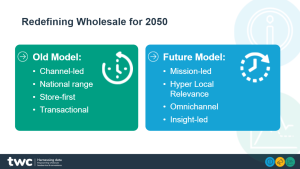
Looking ahead, the UK will see a significant rise in both digital‑native consumers and older shoppers with evolving needs around health, mobility and accessibility. These demographic changes will reshape demand, missions and category performance.
Tanya noted that many traditional wholesale staples, including alcohol and tobacco, remain important but are in long‑term decline. The future lies in helping customers broaden their offering, diversify their range and meet the needs of tomorrow’s consumer.
Why data is the foundation of wholesale resilience
Throughout the session, Tanya reinforced a clear message: resilience is built on insight. In a world where channels are blurring, consumer behaviour is shifting and digital access is accelerating, wholesalers need accurate, timely and actionable data to make confident decisions.
TWC’s market‑leading platforms and analytics give wholesalers, retailers and suppliers the visibility they need to:
- understand evolving shopper behaviour
- identify sustainable growth opportunities
- adapt to demographic change
- support customers in an increasingly digital marketplace
As Tanya concluded, the path to 2050 will reward those who anticipate change, not just react to it. With the right data, the wholesale sector can continue to thrive, innovate and lead.
Find out more about how TWC can help your business.